⚠️ ARCHIVED SITE - HISTORICAL REFERENCE ONLY iHealthFacts is no longer being updated. The information on this site may be out of date and should not be relied upon for health decisions. Please consult current evidence sources.
One high-quality study found that consuming protein with or without added carbohydrates can help increase muscle mass and strength among people who are doing exercise that combines resistance and endurance training.
Other research shows that multi-ingredient protein supplements help to increase the lower and upper body muscle mass and strength as a result of resistance training.
A study reported that the protein supplementation is effective in improving lean body mass (LBM) in adults and older adults, but not handgrip strength and leg press strength.
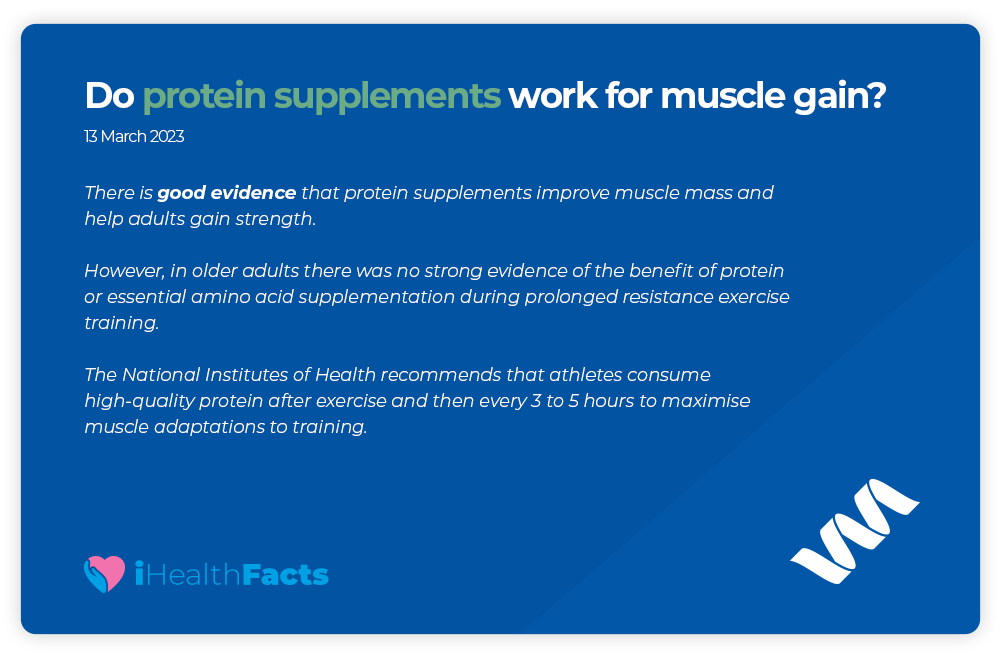
The effect of protein or essential amino acid supplementation during prolonged resistance exercise training in older adults is weak, inconsistent or not significant.
In addition, one study suggested there is no difference between the effects of soy protein versus animal protein supplements on gains in muscle mass and strength in response to resistance exercise. They both increase LBM and strength.
Guidelines and recommendations
National Institutes of Health recommends that athletes consume high-quality protein after exercise and then every 3 to 5 hours to maximise muscle adaptations to training.
Things to Remember
We can rarely be 100% certain about the effects of treatments. Please beware when someone suggests that it is certain that a treatment works or is safe.
Remember to ask if the treatment comparisons in a study happened under ideal circumstances, rather than under real life circumstances. We need to know how a treatment works in real life.
Reviewers
Lead Researcher: Dr. Petek Eylul Taneri, HRB TMRN, College of Medicine, Nursing and Health Sciences, University of Galway.
Reviewed by: Dr. Paula Byrne, Senior post-doctoral researcher, iHealthFacts, Evidence Synthesis Ireland and Cochrane Ireland, College of Medicine, Nursing and Health Sciences, University of Galway.
Topic advisor: Dr. Kevin Cradock, Lecturer, Department of Health and Nutrition Sciences, Atlantic Technological University, Sligo.
Public and Patient advisor: Deirdre Mac Loughlin, Public and Patient Involvement in research (PPI) advisor, PPI Ignite, University of Galway
Journalist Advisor: Dr. Claire O’Connell, PhD in cell biology, Masters in Science Communication. Contributor to The Irish Times, writing about health, science and innovation.
Conflict of Interest Statement: The authors have no financial or other conflicts of interest for this health claim summary.
This website uses cookies to improve your experience. We'll assume you're ok with this, but you can opt-out if you wish. Cookie settingsAcceptRead More
Privacy & Cookies Policy
Privacy Overview
This website uses cookies to improve your experience while you navigate through the website. Out of these cookies, the cookies that are categorized as necessary are stored on your browser as they are essential for the working of basic functionalities of the website. We also use third-party cookies that help us analyze and understand how you use this website. These cookies will be stored in your browser only with your consent. You also have the option to opt-out of these cookies. But opting out of some of these cookies may have an effect on your browsing experience.
Necessary cookies are absolutely essential for the website to function properly. This category only includes cookies that ensures basic functionalities and security features of the website. These cookies do not store any personal information.
Any cookies that may not be particularly necessary for the website to function and is used specifically to collect user personal data via analytics, ads, other embedded contents are termed as non-necessary cookies. It is mandatory to procure user consent prior to running these cookies on your website.