⚠️ ARCHIVED SITE - HISTORICAL REFERENCE ONLY iHealthFacts is no longer being updated. The information on this site may be out of date and should not be relied upon for health decisions. Please consult current evidence sources.
A lot of research suggests a link between MS and having low levels of vitamin D. However, it is not clear whether low vitamin D levels play a part in causing MS, or whether low levels might be as a result of MS.
Most of the studies we found look at either the association between vitamin D levels and developing MS (i.e. whether the two are linked), or they look at effects of people who already have MS taking Vitamin D supplements. These studies do not answer the question of whether vitamin D supplements can stop MS developing in the first place. The reason such studies don’t exist is mostly because it is very difficult to do large-scale prevention trials that would best answer this question.
We found one high-quality observational study that found that women who used supplemental vitamin D had a 40% lower risk of MS than women who did not use vitamin D supplements. However, this supplemental vitamin D intake was largely from multivitamins which contain other vitamins as well as vitamin D. Also, just because a study finds links or associations between two things, this doesn’t prove that one thing is caused by the other.
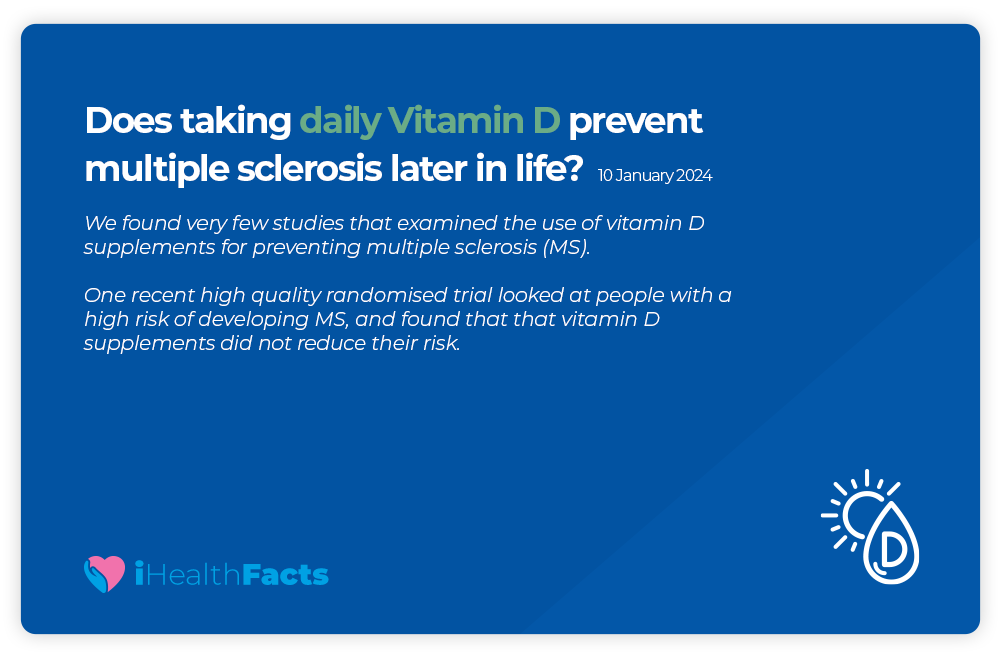
We found two randomised trials that explored the effects of vitamin D supplements in people who have a high risk of developing MS (this is a type of MS called ‘clinically isolated syndrome’ where people who experience it may or may not go on to develop MS).
One was a very small pilot trial of acceptable quality with 30 people (aged 20-40) that reported supplemental vitamin D can reduce the risk of MS developing in this type of patient; however, the other trial was of high quality with 204 people (aged 18-65) and concluded that vitamin D supplements did not reduce the risk of MS.
The dosage of vitamin D supplements used in these two trials (50,000 IU vitamin D3 weekly or up to 10,000 IU of vitamin D3 daily by mouth) was shown to be safe.
Guidelines and recommendations
We found no guidelines specifically on vitamin D supplementation for preventing MS. However, the HSE, the WHO and the CDC recommend vitamin D supplementation for general health.
Things to Remember
Although the two trials we found showed that the dosage of vitamin D they used was safe, it can be harmful to ‘overdose’ on high levels of vitamin D.
Be wary of treatment effects and claims that are based on small studies of few people.
Just because a study finds links or associations between two things, this doesn’t prove that one is caused by the other
Reviewed by: Dr. Paula Byrne, Senior post-doctoral researcher, iHealthFacts, Evidence Synthesis Ireland and Cochrane Ireland, College of Medicine, Nursing and Health Sciences, University of Galway.
Topic advisor: Prof. Francis Finucane, Professor of Medicine University of Galway, Consultant Endocrinologist at Galway University Hospital.
Public and Patient advisor: Anne Daly, Public and Patient Involvement in research (PPI) advisor, PPI Ignite, University of Galway.
Journalist Advisor: Dr. Claire O’Connell, PhD in cell biology, Masters in Science Communication. Contributor to The Irish Times, writing about health, science and innovation.
Conflict of Interest Statement:The authors have no financial or other conflicts of interest for this health claim summary.
This website uses cookies to improve your experience. We'll assume you're ok with this, but you can opt-out if you wish. Cookie settingsAcceptRead More
Privacy & Cookies Policy
Privacy Overview
This website uses cookies to improve your experience while you navigate through the website. Out of these cookies, the cookies that are categorized as necessary are stored on your browser as they are essential for the working of basic functionalities of the website. We also use third-party cookies that help us analyze and understand how you use this website. These cookies will be stored in your browser only with your consent. You also have the option to opt-out of these cookies. But opting out of some of these cookies may have an effect on your browsing experience.
Necessary cookies are absolutely essential for the website to function properly. This category only includes cookies that ensures basic functionalities and security features of the website. These cookies do not store any personal information.
Any cookies that may not be particularly necessary for the website to function and is used specifically to collect user personal data via analytics, ads, other embedded contents are termed as non-necessary cookies. It is mandatory to procure user consent prior to running these cookies on your website.