⚠️ ARCHIVED SITE - HISTORICAL REFERENCE ONLY iHealthFacts is no longer being updated. The information on this site may be out of date and should not be relied upon for health decisions. Please consult current evidence sources.
Cancer is among the leading causes of death worldwide. Some of the treatments for cancer in modern medicine can have severe side effects. Some people are interested in exploring whether treatments known as ‘natural remedies’, for example use of plant extracts, may effectively treat or cure cancer.
Cassava is one such natural remedy whose roots, stems and leaves are used to treat various illnesses. It is the sixth most important crop in the world. The cassava leaf consists of a palm-shaped leaf blade with 3 to 9 lobes, and it comes in different colours.
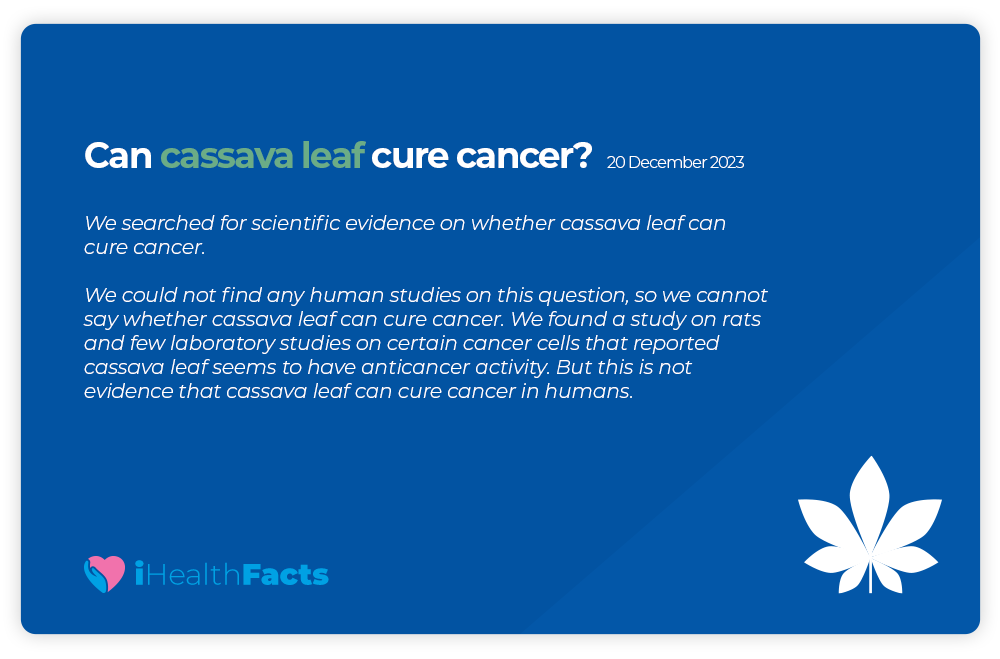
We did not find any human studies on whether cassava leaf can treat cancer, but we found five laboratory-based studies:
Study one was a study on rats and it found that cassava leaf may have anticancer properties.
Studies two, three, four and five looked at the effect of cassava leaf on certain human cancer cells and found that in these laboratory settings, cassava leaf may have anti-cancer properties.
All of these published studies were done as standalone pieces of research, and we found no published reviews of evidence relating to cassava leaf and cancer on cells, animals or humans.
No matter how promising a treatment seems during tests in a laboratory, it must go through rigorous stages of evaluation to ensure it is both effective and safe for humans, using robust study designs such as a randomised control trial (RCT) before its benefits and risks can really be known.
Guidelines and recommendations
We searched several national and international organisations including WHO, ECDC, HSE, and HSPC for related guidelines and recommendations.
We did not find any guidelines or recommendations on the use of cassava leaf for the prevention or treatment of cancer.
Things to Remember
Do remember that there are uncertainties when laboratory research findings are applied to real-life situations without human experiments.
One should be aware that even if the laboratory results are positive and it is likely to be helpful, without trial on the humans it is not possible to predict its efficacy and safety.
Reviewers
Lead Researcher: Dr. Pradnya Kakodkar, Doctoral Researcher, Dentistry & Health Sciences, Symbiosis International (Deemed University), India.
Reviewed by: Dr. Paula Byrne, Senior post-doctoral researcher, iHealthFacts, Evidence Synthesis Ireland and Cochrane Ireland, College of Medicine, Nursing and Health Sciences, University of Galway.
Topic advisor: Dr. Sinéad Lydon, Associate Professor, Discipline of General Practice, School of Medicine, University of Galway.
Public and Patient advisor: Anne Daly, Public and Patient Involvement in Research (PPI) Advisor, PPI Ignite, University of Galway.
Journalist Advisor: Dr. Claire O’Connell, PhD in Cell Biology, Masters in Science Communication. Contributor to The Irish Times, writing about health, science and innovation.
Conflict of Interest Statement: The authors have no financial or other conflicts of interest for this health claim summary.
This website uses cookies to improve your experience. We'll assume you're ok with this, but you can opt-out if you wish. Cookie settingsAcceptRead More
Privacy & Cookies Policy
Privacy Overview
This website uses cookies to improve your experience while you navigate through the website. Out of these cookies, the cookies that are categorized as necessary are stored on your browser as they are essential for the working of basic functionalities of the website. We also use third-party cookies that help us analyze and understand how you use this website. These cookies will be stored in your browser only with your consent. You also have the option to opt-out of these cookies. But opting out of some of these cookies may have an effect on your browsing experience.
Necessary cookies are absolutely essential for the website to function properly. This category only includes cookies that ensures basic functionalities and security features of the website. These cookies do not store any personal information.
Any cookies that may not be particularly necessary for the website to function and is used specifically to collect user personal data via analytics, ads, other embedded contents are termed as non-necessary cookies. It is mandatory to procure user consent prior to running these cookies on your website.