⚠️ ARCHIVED SITE - HISTORICAL REFERENCE ONLY iHealthFacts is no longer being updated. The information on this site may be out of date and should not be relied upon for health decisions. Please consult current evidence sources.
There have been claims on social and in mainstream media that, for the general public, wearing eye glasses can prevent infection from the virus that causes COVID-19.
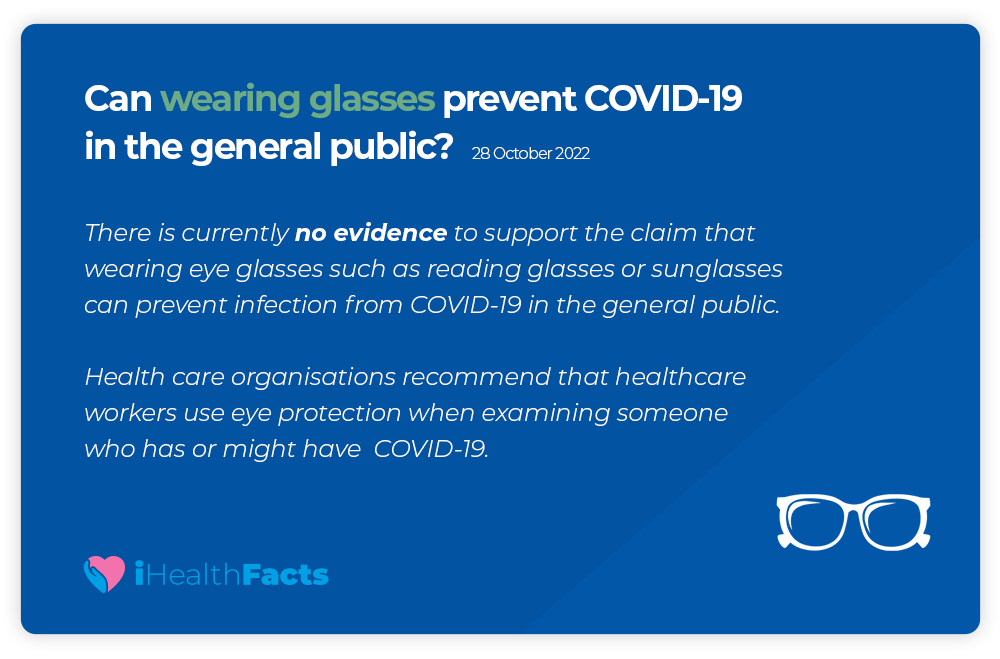
There is currently no research evidence to help us determine if wearing eye glasses can prevent infection from COVID-19 in the general public.
There are currently no national or international guidelines that advise the public to wear eye glasses to prevent infection from COVID-19. However, the Health Service Executive (HSE), the Centers for Disease Control and Prevention (CDC), and the World Health Organization (WHO) recommend that healthcare workers use eye protection when examining someone who has or might have COVID-19.
A review of studies that includes evidence from COVID-19 and other serious respiratory illnesses showed there may be a reduced risk of transmitting an infection when wearing eye protection.
Another review of studiessuggests that there might be a reduction in COVID-19 infections with eye protection.
Just because something is associated with a better (or worse) outcome, that doesn’t mean that it causes the outcome.
If one study shows something, it does not mean that is the final answer.
Reviewers
Lead Researcher: Dr. Petek Eylül Taneri MD, PhD, HRB-Trials Methodology Research Network, University of Galway.
Reviewed by: Prof. Declan Devane, School of Nursing and Midwifery, HRB-Trials Methodology Research Network, Evidence Synthesis Ireland & Cochrane Ireland, University of Galway.
Topic Advisor: Dr. Darren Dahly, Principal Statistician, HRB Clinical Research Facility, Cork, Ireland, and Senior Lecturer in Research Methods in the UCC School of Public Health.
Public and Patient Advisor: Ms Deirdre Mac Loughlin, PPI Ignite, University of Galway.
Journalist Advisor: Dr. Claire O’Connell, Contributor, The Irish Times.
Conflict of Interest Statement: The authors have no financial or other conflicts of interest for this health claim summary.
This website uses cookies to improve your experience. We'll assume you're ok with this, but you can opt-out if you wish. Cookie settingsAcceptRead More
Privacy & Cookies Policy
Privacy Overview
This website uses cookies to improve your experience while you navigate through the website. Out of these cookies, the cookies that are categorized as necessary are stored on your browser as they are essential for the working of basic functionalities of the website. We also use third-party cookies that help us analyze and understand how you use this website. These cookies will be stored in your browser only with your consent. You also have the option to opt-out of these cookies. But opting out of some of these cookies may have an effect on your browsing experience.
Necessary cookies are absolutely essential for the website to function properly. This category only includes cookies that ensures basic functionalities and security features of the website. These cookies do not store any personal information.
Any cookies that may not be particularly necessary for the website to function and is used specifically to collect user personal data via analytics, ads, other embedded contents are termed as non-necessary cookies. It is mandatory to procure user consent prior to running these cookies on your website.