⚠️ ARCHIVED SITE - HISTORICAL REFERENCE ONLY iHealthFacts is no longer being updated. The information on this site may be out of date and should not be relied upon for health decisions. Please consult current evidence sources.
Anecdotally, several “treatments” are thought to lessen the pain of nettle stings. These include rubbing dock leaves (Rumex obtusifolius), sage (Salvia officinalis), peppermint (Mentha x piperita), mud, or even toothpaste on the site of the sting.
These treatments are based on the belief that nettle stings are caused only by a biochemical reaction in the body, resulting in a painful, inflamed skin rash.
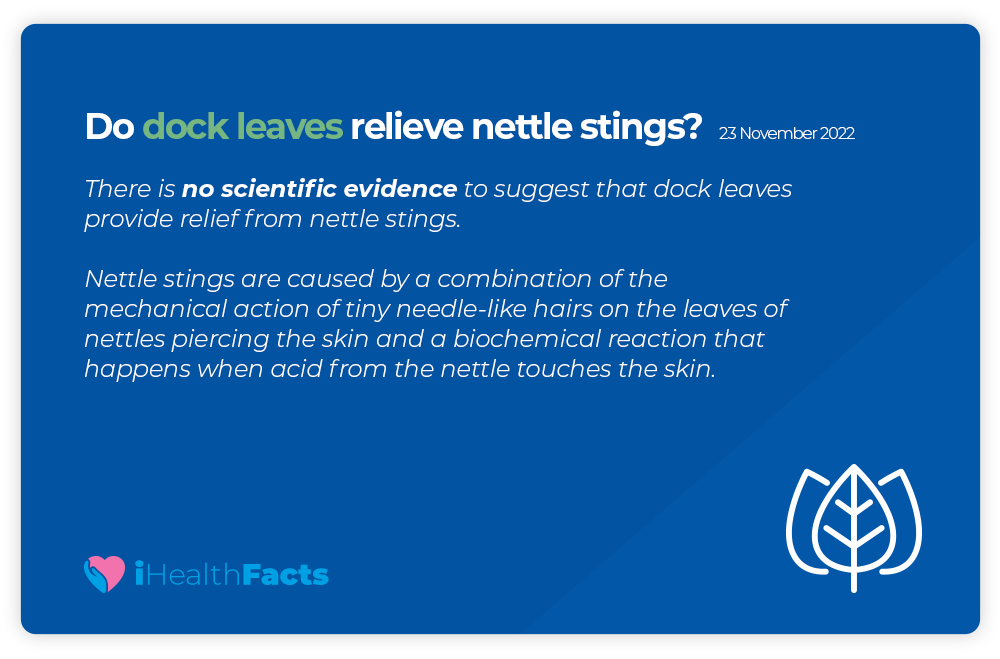
The evidence from animal studies suggests that nettle stings are a combination of a biochemical reaction (from an acid touching the skin) and the mechanical action of tiny hair-like spikes called “trichomes” piercing human skin; therefore treatment may be more complex than previously thought.
It was believed that dock leaves could neutralise the acid in nettle stings. However, we now know that the sap from dock leaves is also acidic, and so it is unlikely to counteract the acid.
It may be that dock leaves were historically used to treat nettle stings based on:
their availability (they usually grow near nettles)
when dock leaves are rubbed onto a nettle sting, they might cause a placebo-based distraction from the sting’s pain (i.e. the person believes the dock leaf will help, and this belief provides a beneficial effect).
Things to Remember
Faulty logic “Old is better!” – Just because a treatment has been used for a long time or by many people, it does not mean that it helps or is safe.
Trust alone “It worked for me!” – If someone got better after using a treatment, it does not necessarily mean that the treatment made them better. There are many other things to consider, even though they are rarely mentioned in casual conversations.
Just because using a treatment is associated with people getting better or worse, that doesn’t mean that the treatment made them better or worse.
Reviewers
Lead Researcher: Dr Sandra Galvin, HRB-Trials Methodology Research Network, University of Galway.
Reviewed by: Professor Declan Devane, School of Nursing and Midwifery, HRB-Trials Methodology Research Network, Evidence Synthesis Ireland & Cochrane Ireland, University of Galway.
Topic Advisor: Prof. Liam Glynn, Professor of General Practice at the Graduate Entry Medical School of Medicine, University of Limerick, Chair of the North Clare Primary Care Team and Rural GP.
Public and Patient Advisor: Ms Anne Daly, Public and Patient Involvement in research (PPI) advisor, PPI Ignite, University of Galway.
Journalist Advisor: Dr. Claire O’Connell, Journalist, Contributor, The Irish Times.
Conflict of Interest Statement: The authors have no financial or other conflicts of interest for this health claim summary.
This website uses cookies to improve your experience. We'll assume you're ok with this, but you can opt-out if you wish. Cookie settingsAcceptRead More
Privacy & Cookies Policy
Privacy Overview
This website uses cookies to improve your experience while you navigate through the website. Out of these cookies, the cookies that are categorized as necessary are stored on your browser as they are essential for the working of basic functionalities of the website. We also use third-party cookies that help us analyze and understand how you use this website. These cookies will be stored in your browser only with your consent. You also have the option to opt-out of these cookies. But opting out of some of these cookies may have an effect on your browsing experience.
Necessary cookies are absolutely essential for the website to function properly. This category only includes cookies that ensures basic functionalities and security features of the website. These cookies do not store any personal information.
Any cookies that may not be particularly necessary for the website to function and is used specifically to collect user personal data via analytics, ads, other embedded contents are termed as non-necessary cookies. It is mandatory to procure user consent prior to running these cookies on your website.