⚠️ ARCHIVED SITE - HISTORICAL REFERENCE ONLY iHealthFacts is no longer being updated. The information on this site may be out of date and should not be relied upon for health decisions. Please consult current evidence sources.
There is evidence that wearing a mask reduces the amount of droplets that get scattered from the nose and mouth, and can protect others from the wearer.
There is general agreement from the World Health Organization (WHO), Centers for Disease Control and Prevention (CDC) and other organisations that people with symptoms of respiratory illness should wear face coverings in combination with other measures (e.g. isolating from others, hand washing and sanitising, containing coughs and sneezes in tissues etc) to help prevent spread of respiratory diseases.
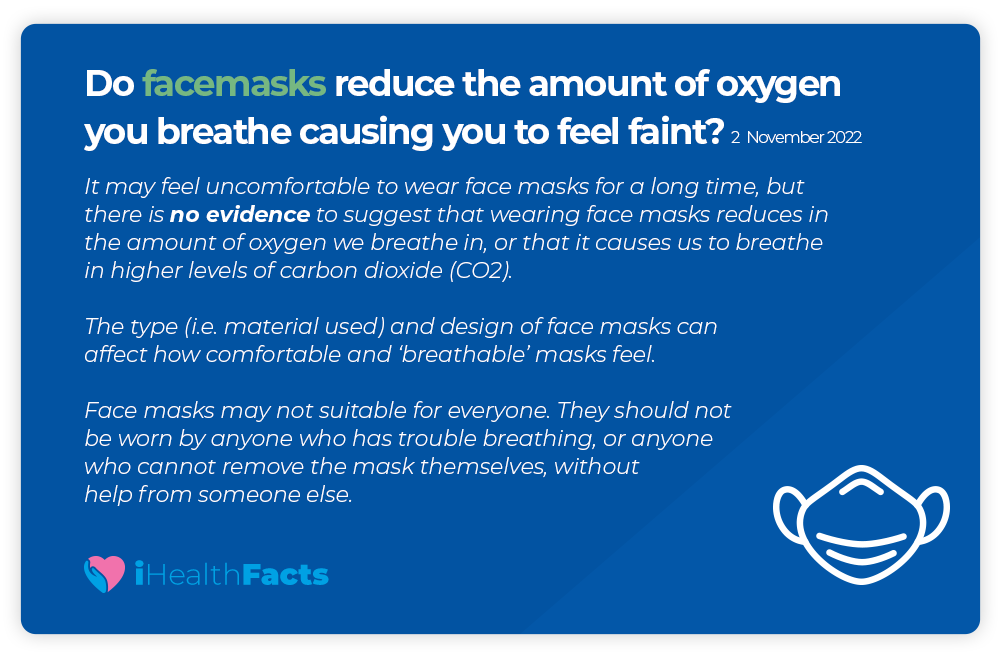
The HSE states that face coverings should NOT be worn by anyone who has trouble breathing, who is incapacitated, or who is otherwise unable to remove the mask without assistance.
The WHO states that the prolonged use of medical masks (flat or pleated masks) when properly worn, does not cause harmful changes in levels of the carbon dioxide or oxygen in the air being breathed in. However, the WHO does not advise people to wear masks when exercising, as masks may reduce the ability to breathe comfortably.
The type (i.e. material used) and design of face masks can affect comfort and perceived breathability.
A cloth face covering should cover the nose and go under the chin and fit snugly but comfortably against the side of the face, and it should include at least 2 layers of fabric and allow for breathing without restriction.
Health agencies recommend that when protecting against Covid-19 and other respiratory diseases, face masks must be used, washed, recycled or disposed of appropriately in combination with other measures eg: handwashing, physical distancing and respiratory etiquette.
Face coverings are not enough on their own to prevent the spread of respiratory diseases including COVID-19. They are NOT a replacement for other recommended measures e.g. hand hygiene, respiratory etiquette, social distancing etc, and people need adequate training on how to safely use face coverings(including how to put them on and take them off safely) before wearing them.
Things to Remember
People’s Opinions alone are not a reliable basis for claims about the effects of treatments.
Lead Researcher: Dr. KM Saif-Ur-Rahman, Evidence Synthesis Ireland and Cochrane Ireland, University of Galway.
Reviewed by: Prof. Declan Devane, College of Medicine, Nursing and Health Sciences, HRB-Trials Methodology Research Network, Evidence Synthesis Ireland & Cochrane Ireland, University of Galway.
Topic Advisor: Prof. Dearbháile Morris School of Medicine, and Centre for One Health, University of Galway.
Public and Patient Advisor: Ms. Deirdre Mac Loughlin, PPI Ignite, University of Galway.
Journalist Advisor: Dr. Claire O’Connell, Contributor, The Irish Times.
Conflict of Interest Statement: The authors have no financial or other conflicts of interest for this health claim summary.
This website uses cookies to improve your experience. We'll assume you're ok with this, but you can opt-out if you wish. Cookie settingsAcceptRead More
Privacy & Cookies Policy
Privacy Overview
This website uses cookies to improve your experience while you navigate through the website. Out of these cookies, the cookies that are categorized as necessary are stored on your browser as they are essential for the working of basic functionalities of the website. We also use third-party cookies that help us analyze and understand how you use this website. These cookies will be stored in your browser only with your consent. You also have the option to opt-out of these cookies. But opting out of some of these cookies may have an effect on your browsing experience.
Necessary cookies are absolutely essential for the website to function properly. This category only includes cookies that ensures basic functionalities and security features of the website. These cookies do not store any personal information.
Any cookies that may not be particularly necessary for the website to function and is used specifically to collect user personal data via analytics, ads, other embedded contents are termed as non-necessary cookies. It is mandatory to procure user consent prior to running these cookies on your website.