⚠️ ARCHIVED SITE - HISTORICAL REFERENCE ONLY iHealthFacts is no longer being updated. The information on this site may be out of date and should not be relied upon for health decisions. Please consult current evidence sources.
Beetroot juice is thought to help lower blood pressure because it contains high levels of nitrate. Our body can turn nitrate into nitric oxide, a compound that helps relax and widen our blood vessels, making it easier for the heart to pump blood. We found three relevant reviews.
The first systematic review with 310 participants was carried out in 2018. It focused on adults consuming beetroot juice, and found evidence supporting its use in lowering blood pressure.
The second systematic review with 493 participants was carried out in 2022 and found that beetroot juice reduced systolic blood pressure (the top number in a blood-pressure reading).
The third systematic review with 218 participants also carried out in 2022 showed similar findings. It reported that beetroot juice reduced systolic blood pressure in people who were diagnosed with high blood pressure. They also found that it was the nitrate in the beetroot juice that was the cause of the reduction.
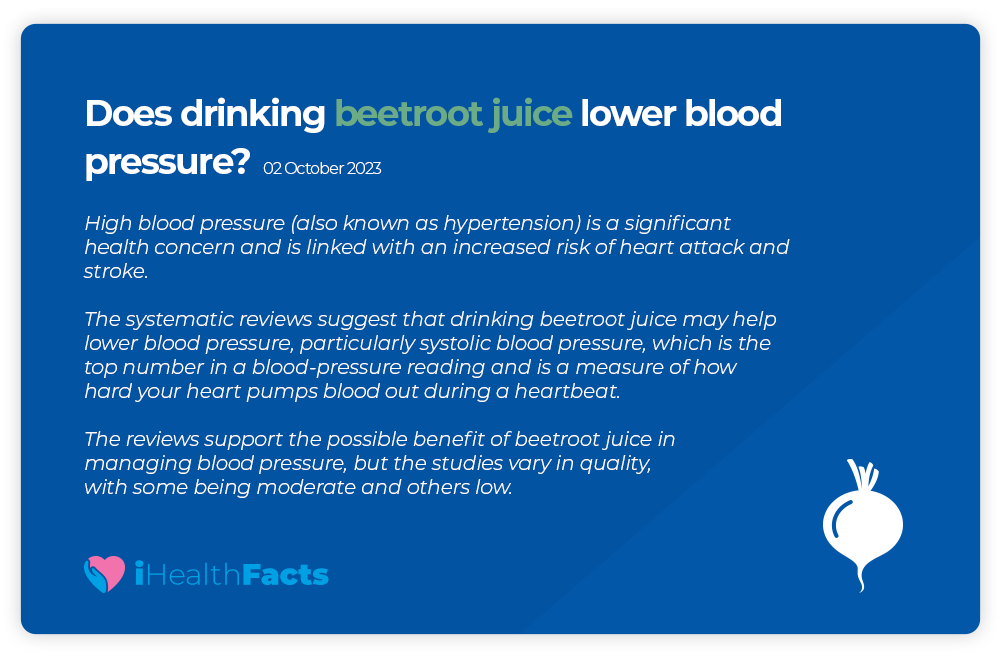
In summary, it seems that drinking beetroot juice might help with lowering blood pressure, particularly the top number (systolic blood pressure). Drinking over 140mls per day seems to have a bigger effect. However, we need more high-quality research, looking at larger doses of beetroot juice and over a longer period, to be sure about how effective and safe it is for long-term control of high blood pressure.
Things to Remember
The findings here are based on systematic reviews, which are summaries of the relevant studies. Be mindful about making treatment decisions that are made based on one study
We can never be fully certain about the effects of treatments. These systematic reviews have suggested that it is important to do more research to examine long-term effects, which will further help our certainty.
Reviewers
Lead Researcher: Dr Marie Tierney, Postdoctoral Researcher, School of Nursing & Midwifery, University of Galway and School of Nursing, Psychotherapy and Community Health, Dublin City University
Reviewed by: Prof Declan Devane, Professor of Health Research Methodology, Deputy Dean, College of Medicine, Nursing and Health Sciences, University of Galway,
Topic advisor: Prof Emma Wallace, Professor of General Practice, Dept of General Practice, University College Cork & General Practitioner, Parklands Surgery, Commons Road, Cork.
Public and Patient advisor: Anne Daly, Public and Patient Involvement in research (PPI) advisor, PPI Ignite, University of Galway.
Journalist Advisor: Dr. Claire O’Connell, PhD in cell biology, Masters in Science Communication. Contributor to The Irish Times, writing about health, science and innovation.
Conflict of Interest Statement: The authors have no financial or other conflicts of interest for this health claim summary.
This website uses cookies to improve your experience. We'll assume you're ok with this, but you can opt-out if you wish. Cookie settingsAcceptRead More
Privacy & Cookies Policy
Privacy Overview
This website uses cookies to improve your experience while you navigate through the website. Out of these cookies, the cookies that are categorized as necessary are stored on your browser as they are essential for the working of basic functionalities of the website. We also use third-party cookies that help us analyze and understand how you use this website. These cookies will be stored in your browser only with your consent. You also have the option to opt-out of these cookies. But opting out of some of these cookies may have an effect on your browsing experience.
Necessary cookies are absolutely essential for the website to function properly. This category only includes cookies that ensures basic functionalities and security features of the website. These cookies do not store any personal information.
Any cookies that may not be particularly necessary for the website to function and is used specifically to collect user personal data via analytics, ads, other embedded contents are termed as non-necessary cookies. It is mandatory to procure user consent prior to running these cookies on your website.