⚠️ ARCHIVED SITE - HISTORICAL REFERENCE ONLY iHealthFacts is no longer being updated. The information on this site may be out of date and should not be relied upon for health decisions. Please consult current evidence sources.
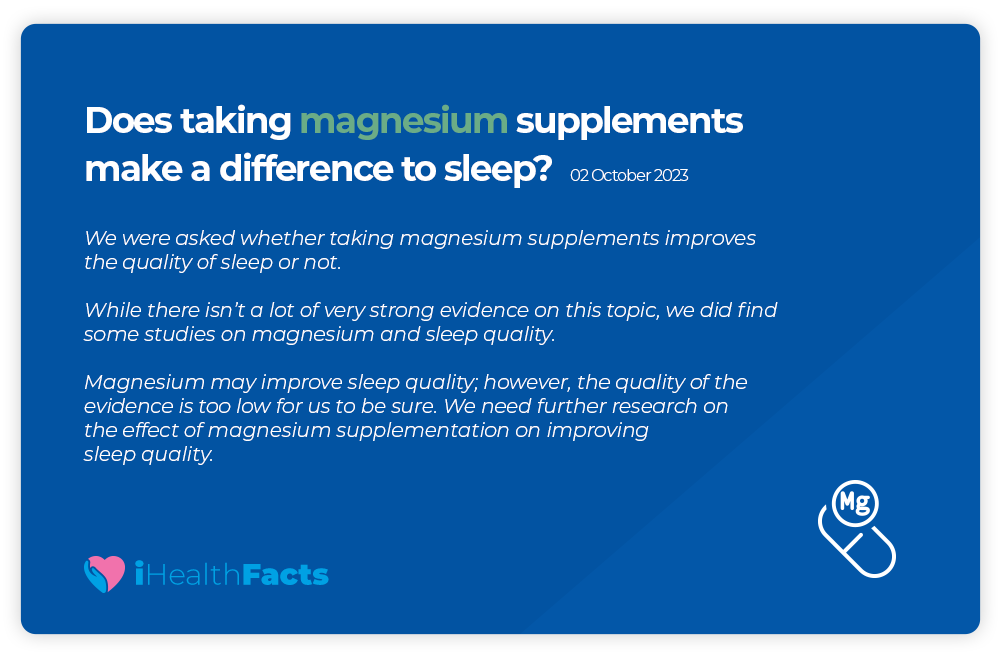
It has been claimed that taking magnesium supplements improves the quality of sleep.
We looked for studies to find out whether or not magnesium supplements improve the quality of sleep.
We found three relevant, high-quality systematic reviews. However, while a systematic review might be of high quality (that is, it’s been done correctly), sometime the studies included in the review are of low quality. This is why, sometimes, as you’ll see below, you can have a high-quality review of low-quality studies.
The first systematic review reported that magnesium supplements improve sleep onset and improve insomnia symptoms. However, the results came from low or very low-quality studies.
The second systematic review looked at randomised controlled trials (5 RCTs) and observational studies (1 cohort study and 3 cross-sectional studies). The RCTs reported that magnesium supplements have an uncertain effect on sleep. The observational studies denoted that magnesium may improve sleep quality. However, observational studies cannot prove that something caused something else. This is because this type of study doesn’t compare two similar groups of people; one which takes magnesium and one which does not, making sure you’ve a fair comparison.
The third systematic review included two RCTs, which found no beneficial effect of magnesium supplements on sleep quality.
Overall, none of the systematic reviews we found could be certain that magnesium supplements improve sleep quality.
Further research is needed to figure this out.
Guidelines and recommendations
We searched several national and international organisations including WHO, CDC, ECDC, HSE, and HSPC for related guidelines and recommendations. We did not get any recommendations on the use of Magnesium supplements in relation to sleep quality.
Things to Remember
Just because one study shows that people who got a treatment did better or worse than those who did not, does not mean it’s the final answer.
If someone gets better after a treatment, it does not necessarily or always mean that the treatment made them better.
Lead Researcher: Dr KM Saif-Ur-Rahman, Senior Research Methodologist, Evidence Synthesis Ireland and Cochrane Ireland, College of Medicine, Nursing and Health Sciences, University of Galway.
Reviewed by: Dr Paula Byrne, Senior post-doctoral researcher, iHealthFacts, Evidence Synthesis Ireland and Cochrane Ireland, College of Medicine, Nursing and Health Sciences, University of Galway.
Topic advisor: Prof Andrew Murphy, College of Medicine, Nursing and Health Sciences, University of Galway, Health Research Board Primary Care Clinical Trials Network Ireland and General Practitioner principal in a semi-rural setting.
Public and Patient advisor: Anne Daly, Public and Patient Involvement in research (PPI) advisor, PPI Ignite, University of Galway.
Journalist Advisor: Dr Claire O’Connell, PhD in cell biology, Masters in Science Communication. Contributor to The Irish Times, writing about health, science and innovation.
Conflict of Interest Statement: The authors have no financial or other conflicts of interest for this health claim summary.
This website uses cookies to improve your experience. We'll assume you're ok with this, but you can opt-out if you wish. Cookie settingsAcceptRead More
Privacy & Cookies Policy
Privacy Overview
This website uses cookies to improve your experience while you navigate through the website. Out of these cookies, the cookies that are categorized as necessary are stored on your browser as they are essential for the working of basic functionalities of the website. We also use third-party cookies that help us analyze and understand how you use this website. These cookies will be stored in your browser only with your consent. You also have the option to opt-out of these cookies. But opting out of some of these cookies may have an effect on your browsing experience.
Necessary cookies are absolutely essential for the website to function properly. This category only includes cookies that ensures basic functionalities and security features of the website. These cookies do not store any personal information.
Any cookies that may not be particularly necessary for the website to function and is used specifically to collect user personal data via analytics, ads, other embedded contents are termed as non-necessary cookies. It is mandatory to procure user consent prior to running these cookies on your website.