⚠️ ARCHIVED SITE - HISTORICAL REFERENCE ONLY iHealthFacts is no longer being updated. The information on this site may be out of date and should not be relied upon for health decisions. Please consult current evidence sources.
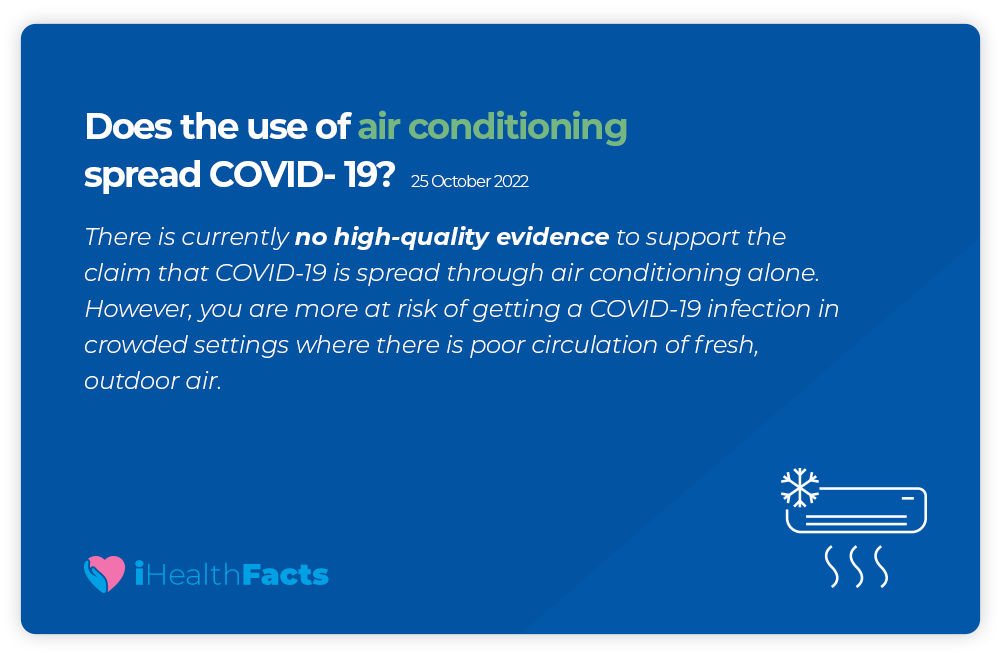
Claims have been circulated on social media that using air conditioning may lead to the spread of COVID-19.
Heating, ventilation and air conditioning (HVAC) systems are used in indoor spaces to provide comfortable environmental conditions of temperature and humidity (moisture in the air).
There are various types of HVAC systems. Ventilation systems provide clean air by exchanging indoor and outdoor air and filtering. Air conditioning systems provide varying temperatures and take excess moisture from the air.
The various types of HVAC systems mean that it is difficult to generalise the results of studies that have taken place to date on the transmission of previous coronaviruses (e.g. SARS) through these systems.
In spaces and buildings such as homes, schools and offices, the World Health Organization (WHO) recommends increased ventilation through natural (e.g. opening windows) or mechanical (e.g. HVAC systems that introduce outdoor air) means, preferably without systems that recirculate the air.
Air conditioning and industrial ventilation systems in public spaces and buildings should be inspected, maintained, and cleaned regularly to ensure systems are working properly
The European Centre for Disease Prevention and Control states that well-maintained HVAC systems can help to decrease the spread of COVID-19.
Things to Remember
Beware ofclaims that are based on a single study. Ask if other studies examine the same question and, ideally, if there a careful summary of all the relevant studies.
Beware of claims that are based on before and after comparisons, and when people don’t say what atreatment was compared to. Remember: Ask what the treatment was compared to and whether it was a fair comparison.
Lead Researcher: Dr. Claire Beecher, HRB-Trials Methodology Research Network & Evidence Synthesis Ireland, University of Galway
Reviewed by: Prof. Declan Devane, School of Nursing and Midwifery, HRB-Trials Methodology Research Network, Evidence Synthesis Ireland & Cochrane Ireland, University of Galway.
Topic Advisor: Prof. Andrew Murphy, General Practice, University of Galway, Health Research Board Primary Care Clinical Trials Network Ireland
Public and Patient Advisor: Anne Daly, PPI Ignite, University of Galway.
Journalist Advisor: Dr. Claire O’Connell, Contributor, The Irish Times.
Conflict of Interest Statement: The authors have no financial or other conflicts of interest for this health claim summary.
This website uses cookies to improve your experience. We'll assume you're ok with this, but you can opt-out if you wish. Cookie settingsAcceptRead More
Privacy & Cookies Policy
Privacy Overview
This website uses cookies to improve your experience while you navigate through the website. Out of these cookies, the cookies that are categorized as necessary are stored on your browser as they are essential for the working of basic functionalities of the website. We also use third-party cookies that help us analyze and understand how you use this website. These cookies will be stored in your browser only with your consent. You also have the option to opt-out of these cookies. But opting out of some of these cookies may have an effect on your browsing experience.
Necessary cookies are absolutely essential for the website to function properly. This category only includes cookies that ensures basic functionalities and security features of the website. These cookies do not store any personal information.
Any cookies that may not be particularly necessary for the website to function and is used specifically to collect user personal data via analytics, ads, other embedded contents are termed as non-necessary cookies. It is mandatory to procure user consent prior to running these cookies on your website.