⚠️ ARCHIVED SITE - HISTORICAL REFERENCE ONLY iHealthFacts is no longer being updated. The information on this site may be out of date and should not be relied upon for health decisions. Please consult current evidence sources.
Dementia is a condition when someone has trouble with their memory and thinking skills, to the point that it affects their daily life.
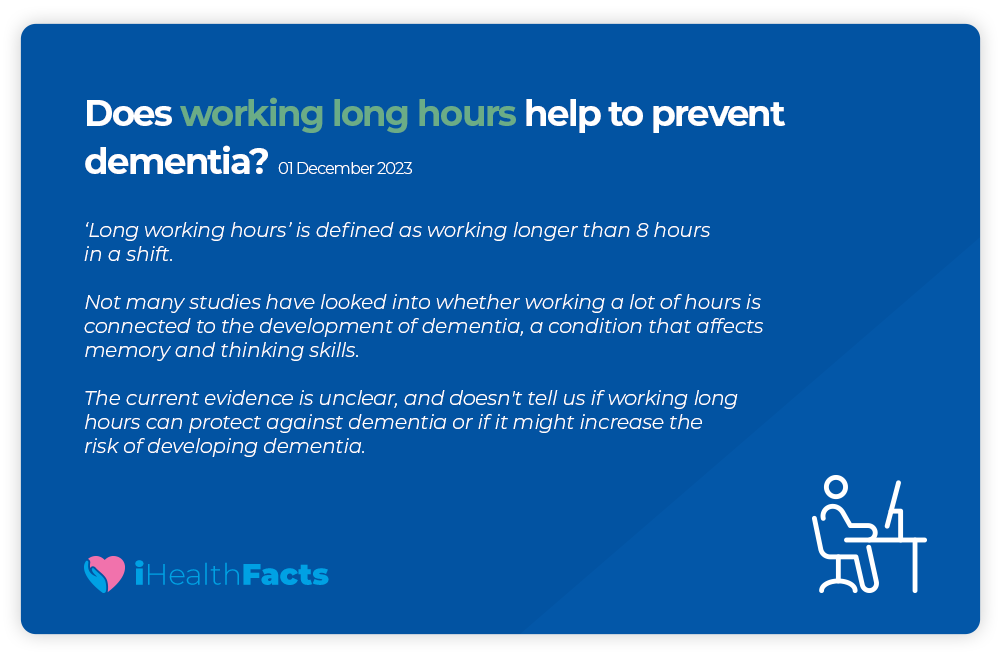
It has been claimed that long working hours might help to prevent dementia.
We looked for studies to find out whether or not long working hours help to prevent dementia.
We found one relevant systematic review conducted on this topic. The quality of the review was good, but it included only one study that was relevant to our research question.
The systematic review explored the link between long working hours (working longer than 8 hours in a shift) and cognitive performance. Cognitive performance refers to how well our brain works and how we think, learn, and remember things. The systematic review considered a type of study that looked at long working hours on worker’s cognitive functions at one point in time (cross-sectional study). The study found that people who work longer hours are more likely to experience a decrease in their ability to think and remember things or affect how well the brain functions. However, many things could account for this, and it is not possible to say for sure if this finding was due to chance, or if the decrease in the ability to think and remember things was due to something other than how long someone works.
We identified three individual studies on long working hours and dementia. All three studies were cohort studies. In this type of study, researchers follow a group of people who haven’t experienced a particular event or condition (like dementia) over a period of time. They observe what happens to those individuals and compare the characteristics of those who eventually experience the event (like developing dementia) with those who don’t. This helps researchers to understand what factors might be associated with the occurrence of that event.
The first study reported that people who worked long hours (defined as working more than 37 hours in a week) had a greater chance of developing dementia.
The second study found that working long hours (more than 9 hours per day) in midlife lowers the chances of experiencing mild cognitive impairment later in life. Mild Cognitive Impairment is a condition when someone has some trouble with their memory and thinking that’s more than usual for their age, but not as severe as dementia.
The third study found that there is no link between working long hours (defined as more than 45 hours per week) and the development of dementia.
Guidelines and recommendations
We searched several national and international organisations, including the World Health Organization (WHO), Centers for Disease Control and Prevention (CDC), and Health Service Executive (HSE), for related guidelines and recommendations.
We did not find any guidelines or recommendations relating to long working hours and dementia.
Things to Remember
If one study shows something, it does not mean that it is the final answer.
Just because a claim is made by an expert or authority, you cannot be sure that it is trustworthy.
Lead Researcher: Dr. KM Saif-Ur-Rahman, Senior Research Methodologist, Evidence Synthesis Ireland and Cochrane Ireland, College of Medicine, Nursing and Health Sciences, University of Galway.
Reviewed by: Prof Declan Devane, Professor of Health Research Methodology, Deputy Dean, College of Medicine, Nursing and Health Sciences, University of Galway, Scientific Director, HRB-Trials Methodology Research Network Director, Evidence Synthesis Ireland. Director, Cochrane Ireland.
Topic advisor: Dr. Darren Dahly, Principal Statistician, HRB Clinical Research Facility, Cork, Ireland, and Senior Lecturer in Research Methods in the UCC School of Public Health.
Public and Patient advisor: Deirdre Mac Loughlin, Public and Patient Involvement in research (PPI) advisor, PPI Ignite, University of Galway.
Journalist Advisor: Dr. Claire O’Connell, PhD in cell biology, Masters in Science Communication. Contributor to The Irish Times, writing about health, science and innovation.
Conflict of Interest Statement:The authors have no financial or other conflicts of interest for this health claim summary.
This website uses cookies to improve your experience. We'll assume you're ok with this, but you can opt-out if you wish. Cookie settingsAcceptRead More
Privacy & Cookies Policy
Privacy Overview
This website uses cookies to improve your experience while you navigate through the website. Out of these cookies, the cookies that are categorized as necessary are stored on your browser as they are essential for the working of basic functionalities of the website. We also use third-party cookies that help us analyze and understand how you use this website. These cookies will be stored in your browser only with your consent. You also have the option to opt-out of these cookies. But opting out of some of these cookies may have an effect on your browsing experience.
Necessary cookies are absolutely essential for the website to function properly. This category only includes cookies that ensures basic functionalities and security features of the website. These cookies do not store any personal information.
Any cookies that may not be particularly necessary for the website to function and is used specifically to collect user personal data via analytics, ads, other embedded contents are termed as non-necessary cookies. It is mandatory to procure user consent prior to running these cookies on your website.