⚠️ ARCHIVED SITE - HISTORICAL REFERENCE ONLY iHealthFacts is no longer being updated. The information on this site may be out of date and should not be relied upon for health decisions. Please consult current evidence sources.
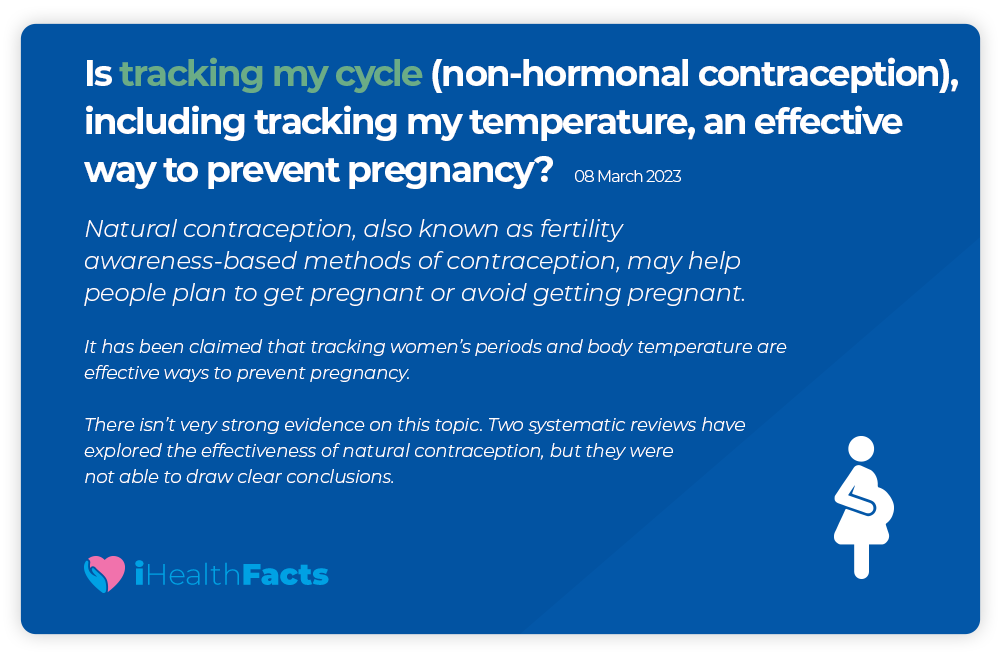
Natural contraception (also called natural family planning or fertility awareness-based methods) is a method of contraception where a woman can track her menstrual cycle and monitor different fertility signals (such as changes in vaginal discharge and basal body temperature) to identify when she is likely to get pregnant.
A 2018 systematic review found no high quality research and concluded that pregnancy rates varied widely across different fertility awareness-based methods. The differences among the populations examined in the studies made it impossible for this review to compare natural contraception methods.
A 2004 Cochrane systematic review concluded that the effectiveness of fertility awareness-based methods of contraception remains unknown. The studies in the review identified difficulty in recruiting participants. Also, large numbers of participants dropped out before the research period was over, making the results weak.
A big issue with studies of natural contraceptions is that pregnancy rates or probabilities of pregnancy and how these are reported varied widely across different fertility awareness-based methods, so we cannot be certain about this type of evidence.
Guidelines and recommendations
According to the NHS, natural family planning methods can be effective if the instructions are carefully followed. They say that if natural family planning methods are not followed correctly, then there is more possibility to get pregnant. Also, stress, illness, travel, lifestyle and hormonal treatments can disrupt fertility signs and natural family planning methods.
According to the US CDC, fertility awareness-based methods can help to avoid getting pregnant. However, they say that it may work for women with a regular menstrual cycles, and the failure rates vary across these methods.
Things to Remember
If one study shows something, it does not mean that is the final answer.
Just because a claim is made by an expert or authority, you cannot be sure that it is trustworthy.
Drafted by: Dr. KM Saif-Ur-Rahman, Evidence Synthesis Ireland and Cochrane Ireland, University of Galway.
Reviewed by: Prof Declan Devane, School of Nursing and Midwifery, HRB-Trials Methodology Research Network, Evidence Synthesis Ireland & Cochrane Ireland, University of Galway.
Topic Advisor: Caroline Mc Carthy. Clinical Lecturer and Research Fellow, Department of General Practice, RCSI University of Medicine and Health Sciences and General Practitioner, Leixlip, Co Kildare.
Public and patient advisor: Ms Anne Daly, Public and Patient Involvement in research (PPI) advisor, PPI Ignite, University of Galway.
Journalistic advisor: Claire O’Connell,Contributor to The Irish Times, writing about health, science and innovation.
This website uses cookies to improve your experience. We'll assume you're ok with this, but you can opt-out if you wish. Cookie settingsAcceptRead More
Privacy & Cookies Policy
Privacy Overview
This website uses cookies to improve your experience while you navigate through the website. Out of these cookies, the cookies that are categorized as necessary are stored on your browser as they are essential for the working of basic functionalities of the website. We also use third-party cookies that help us analyze and understand how you use this website. These cookies will be stored in your browser only with your consent. You also have the option to opt-out of these cookies. But opting out of some of these cookies may have an effect on your browsing experience.
Necessary cookies are absolutely essential for the website to function properly. This category only includes cookies that ensures basic functionalities and security features of the website. These cookies do not store any personal information.
Any cookies that may not be particularly necessary for the website to function and is used specifically to collect user personal data via analytics, ads, other embedded contents are termed as non-necessary cookies. It is mandatory to procure user consent prior to running these cookies on your website.