⚠️ ARCHIVED SITE - HISTORICAL REFERENCE ONLY iHealthFacts is no longer being updated. The information on this site may be out of date and should not be relied upon for health decisions. Please consult current evidence sources.
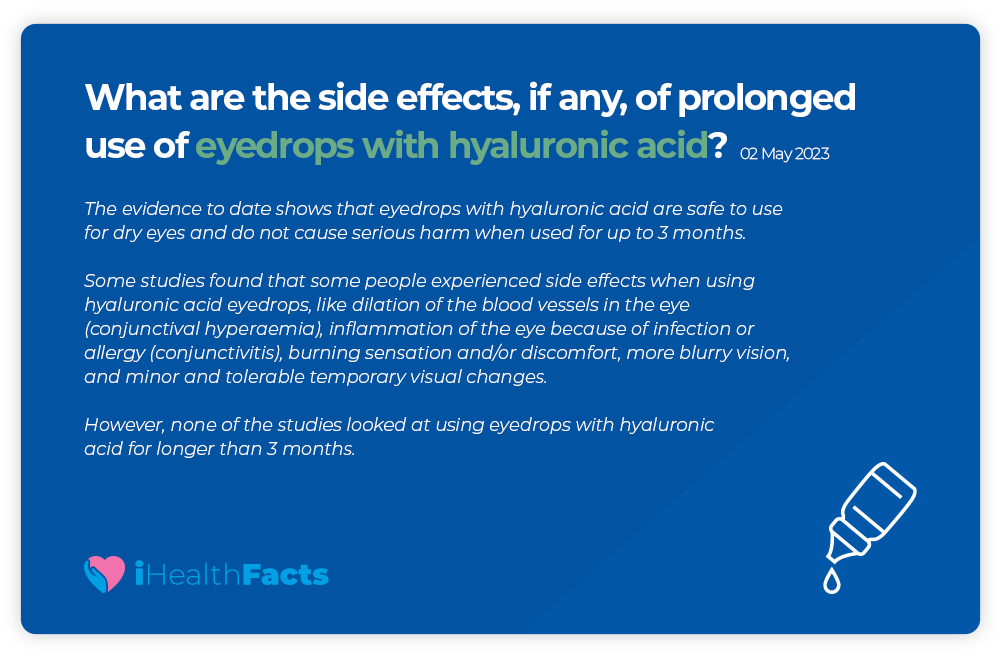
A systematic review published in 2022, which included 53 studies with 4885 people, found that eyedrops with hyaluronic acid are safe to use for dry eye disease, as they don’t cause any serious harm.
Some of the studies found that some people experienced side effects when using hyaluronic acid eyedrops, like dilation of the blood vessels in the eye (conjunctival hyperaemia), inflammation of the eye because of infection or allergy (conjunctivitis), burning sensation and/or discomfort, more blurry vision, and minor and tolerable temporary visual changes.
The majority of these 53 studies were randomised controlled trials, which when done well are considered high-quality evidence. However, the authors of the systematic review did not assess or report on the quality of each of these studies.
None of the 53 studies lasted longer than 3 months, so we can’t be certain that hyaluronic acid eyedrops are safe or don’t have additional side effects when used for a prolonged time.
Guidelines and recommendations
We did not find any guidelines or recommendations on this topic.
Things to Remember
In order to get an accurate answer to your question remember to ask yourself if the outcomes that are relevant to you have been assessed.
There are very few treatments that are 100% safe and there are generally always some side effects to be aware of.
Reviewers
Lead Researcher: Dr Marie Tierney, Postdoctoral Researcher, Informed Health Choices-Cancer project, School of Nursing & Midwifery, University of Galway.
Reviewed by: Prof Declan Devane, Professor of Health Research Methodology, Deputy Dean, College of Medicine, Nursing and Health Sciences, University of Galway,
Topic advisor: Dr. Frank Moriarty,Senior Lecturer in Pharmacy at the School of Pharmacy and Biomolecular Sciences, Royal College of Surgeons in Ireland and visiting research fellow at The Irish Longitudinal Study on Ageing (TILDA).
Public and Patient advisor: Anne Daly, Public and Patient Involvement in research (PPI) advisor, PPI Ignite, University of Galway.
Journalist Advisor: Dr. Claire O’Connell, PhD in cell biology, Masters in Science Communication. Contributor to The Irish Times, writing about health, science and innovation.
Conflict of Interest Statement: The authors have no financial or other conflicts of interest for this health claim summary.
This website uses cookies to improve your experience. We'll assume you're ok with this, but you can opt-out if you wish. Cookie settingsAcceptRead More
Privacy & Cookies Policy
Privacy Overview
This website uses cookies to improve your experience while you navigate through the website. Out of these cookies, the cookies that are categorized as necessary are stored on your browser as they are essential for the working of basic functionalities of the website. We also use third-party cookies that help us analyze and understand how you use this website. These cookies will be stored in your browser only with your consent. You also have the option to opt-out of these cookies. But opting out of some of these cookies may have an effect on your browsing experience.
Necessary cookies are absolutely essential for the website to function properly. This category only includes cookies that ensures basic functionalities and security features of the website. These cookies do not store any personal information.
Any cookies that may not be particularly necessary for the website to function and is used specifically to collect user personal data via analytics, ads, other embedded contents are termed as non-necessary cookies. It is mandatory to procure user consent prior to running these cookies on your website.